

- TOP
- Investor Relations
- Sustainability
- Environment
- Climate Change
Climate Change


Initiatives to Address Climate Change
We position our response to environmental issues, including climate change, as one of our key management priorities.
From June 2022, we disclose the following information based on the recommendations of the TCFD (Task Force on Climate-related Financial Disclosures).
Governance
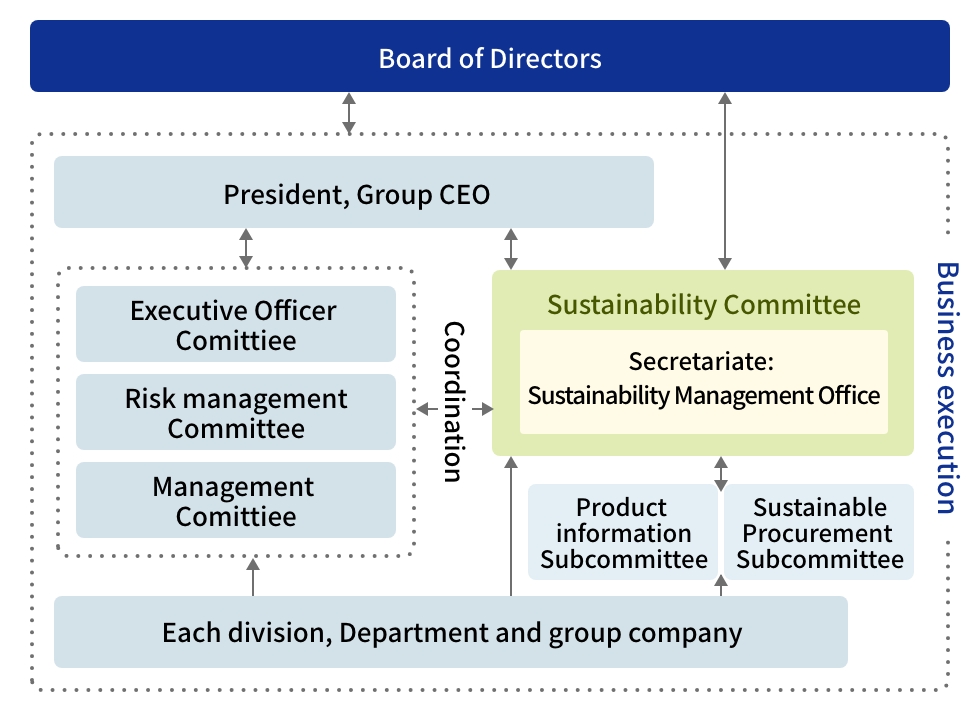
To address sustainability-related matters, we have established a Sustainability Committee as the promoting body within the executive function. The Sustainability Committee comprises all internal directors, including the Representative Director and President, and all executive officers, with one outside director who serves as an Audit and Supervisory Committee member participating as an observer. In principle, it meets twice a year to deliberate and decide on materiality, responses to climate change-related risks and opportunities, and other sustainability matters, and reports the outcomes to the Board of Directors.
We have also established working groups under the Sustainability Committee to conduct cross-organizational activities according to their objectives, and to report their activities to the Sustainability Committee. The working groups currently in place are the Product Information Working Group, which develops carbon footprint and eco-information, and the Sustainable Procurement Working Group, which works to reduce supply-chain risks such as CO2 reduction and human rights issues.
Our sustainability-related governance structure is as follows.
Strategy
To assess the materiality of climate-related risks and opportunities, the Sustainability Promotion Office identifies items with business impact from company-wide risks by classifying them into "transition risks," "physical risks," and "opportunities," and conducts scenario identification and assessment. The main risks and opportunities are as follows.
Scenarios used
With reference to the IPCC (Intergovernmental Panel on Climate Change) Sixth Assessment Report, we use SSP5-8.5 as a scenario, which assumes the highest dependence on fossil fuels and no implementation of climate policies.
In addition, various analyses based on the scenarios refer to IEA (International Energy Agency) scenarios.
Scenario analysis
| Category | Drivers | Impacts on business | Scenario | Finance Impact | Timing of occurrence | Priority | Response measures | |
| Transition risk | Policy and legal/ regulatory |
|
|
1.5℃ | High | Medium term | High |
|
| Technology |
|
|
1.5℃ | Low | Medium term | Medium |
|
|
| Market |
|
|
1.5℃ | Medium | Medium term | Medium |
|
|
| Reputation |
|
|
1.5℃ | Low | Medium term | Low |
|
|
| Physical risk | Acute |
|
|
4℃ | High | Medium term | High |
|
| Chronic |
|
|
4℃ | Low | Medium term | Low |
|
|
| Category | Drivers | Impacts on business | Scenario | Finance Impact | Timing of occurrence | Priority | Response measures | |
| Opportunities | Resource efficiency |
|
|
1.5℃ | High | Long term | Medium |
|
| Energy |
|
|
1.5℃ | Medium | Long term | Low |
|
|
| Market |
|
|
1.5℃ | High | Medium term | High |
|
|
|
4℃ | Medium | Medium term | Medium |
|
|||
| Products and services |
|
|
1.5℃ | Low | Medium term | High |
|
|
|
|
4℃ | Low | Medium term | Medium |
|
||
| Resilience |
|
|
4℃ | Medium | Long term | Medium |
|
|
Risk Management
ased on the "Risk Management Regulations," our Group engages in risk management by identifying, assessing, and responding at the company-wide level to risks that could impede business execution. Sustainability-related risks are managed by the Sustainability Committee at least once a year as part of deliberations on the status of responses to materiality, and the details are reported to the Board of Directors.
Potential risks, including sustainability-related risks, are comprehensively identified from within the Group, integrated as company-wide risks, and then deliberated by the Executive Officers' Meeting in terms of identification, assessment, and responses.
Indicators and targets
We have set the following reduction targets for Scope 1 and 2 emissions from our own operations. In calculating Scope 2, from this reporting year we include all six Group companies.
| Metric | Base year FY03/2021 |
Actual results FY03/2026 |
Interim target FY03/2031 |
Final target FY03/2051 |
| Scope 1 and 2Reduction rate vs. base year | ー | 63% | 42% | 100% |
For Scope 3, Category 1 emissions related to the purchase of the more than 14 million items we handle account for the majority; therefore, we are currently considering response measures, including collaboration with the supply chain.
In addition, to reduce Scope 2 emissions, our Group supports the "RE Action" initiative under the "Renewable Energy 100 Declaration," which aims to switch 100% of electricity used to renewable energy by 2050. In adopting renewable energy as well, we have set reduction targets similar to those for Scope 1 and 2 and are increasing the usage rate.
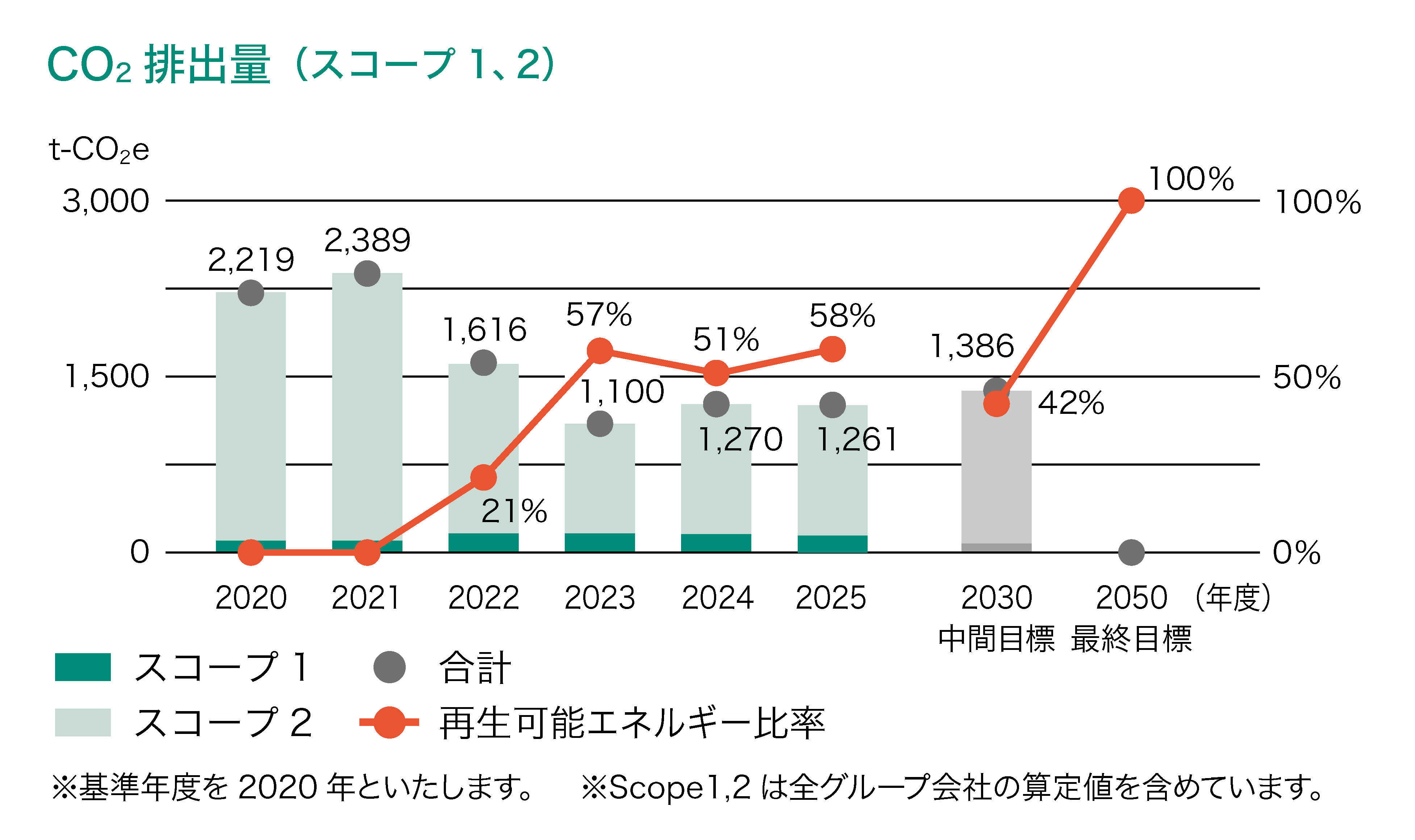
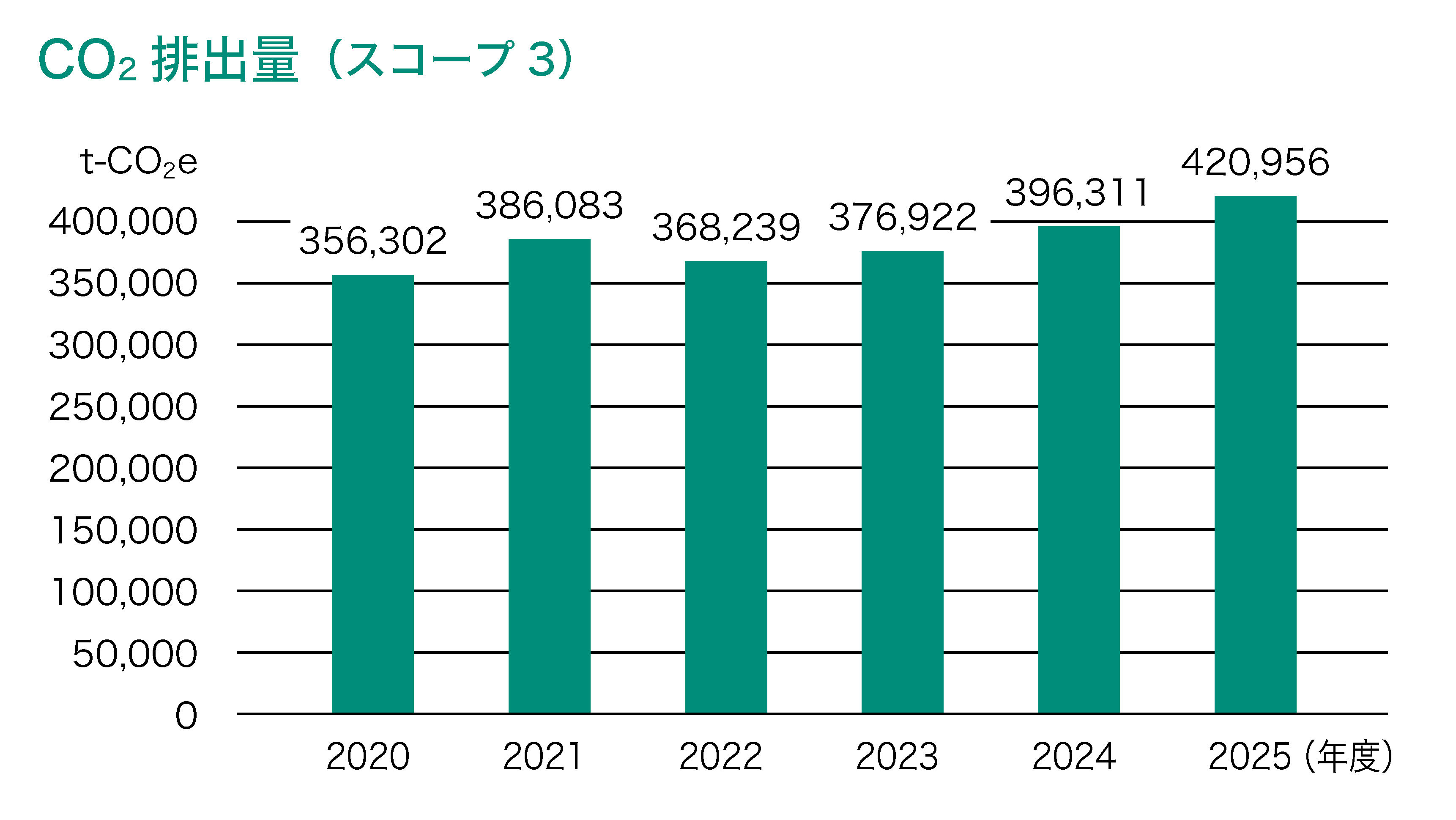
We set *2020 as the reference year.
CDP

We respond to CDP, an NGO that encourages companies and local governments to disclose environmental information.